
Real Superheroes
Sage Michael finds out what it’s like to be a superhero in the real world.

If you hang around Bigfoot message boards long enough, you’ll hear some version of the claim: the FBI once tested Sasquatch hair and couldn’t identify it. It sounds like conspiracy-flavored folklore, the kind of thing that gets repeated so many times nobody remembers where it started.
The twist is that it’s half true. The FBI really did test hair that a serious researcher believed had come from a Bigfoot. And we know exactly what the Bureau concluded, because the entire case file has been sitting on the FBI’s public records website since 2019.
We read the whole thing. Here’s what actually happened.
In 1975, the U.S. Army Corps of Engineers put out a reference work called the Washington Environmental Atlas. It was a $200,000 guide to the natural features of Washington State, and tucked into its pages was a section on Sasquatch — described as standing up to twelve feet tall, weighing half a ton, and covered head to toe in long hair. The entry went on to note that a sample of reputed Sasquatch hair had been analyzed by the FBI and found to match no known animal.
For one reader in The Dalles, Oregon, that was all it took.
Peter Byrne ran the Bigfoot Information Center and Exhibition, a small museum and research outfit on West Sixth Street in The Dalles. He was a former professional big-game hunter who had done a complete 180 and spent the rest of his life investigating creatures he had no intention of shooting — first the Yeti in Nepal, then the Loch Ness Monster, and by the mid-seventies, Sasquatch. He’d been at the Bigfoot work for about six years when the Army atlas landed on his desk.
By the contemporary news coverage, Byrne was about as buttoned-up as a Bigfoot hunter could be. He turned down dubious sightings. He cast a skeptical eye at famous footage. He was the kind of researcher who was more likely to talk you out of believing something than into it.
So in August 1976, he sat down and wrote the FBI a very polite letter. The gist: Did you actually do this? Because we keep hearing about it, and we’d like to know, one way or the other.
Two weeks later, Assistant Director Jay Cochran, Jr. of the FBI’s Laboratory Division wrote back. The Bureau, he said, had received several inquiries along these same lines since the Army atlas came out. They had searched their files and could not find any record of ever examining Bigfoot hair. They had even tracked down the editor of the atlas — a Dr. Steve Rice, up in Seattle — and asked him where he’d gotten the claim. Rice couldn’t find his source either.
So the famous “FBI confirmed Sasquatch hair is unknown” story was a game of telephone that nobody could trace back to the first caller.
A normal person would have let it drop there.
Byrne instead wrote back three months later with a proposition. The Bigfoot Information Center, as it happened, had just come into possession of a sample: roughly fifteen hairs attached to a small piece of skin. It was the first such specimen they’d obtained in six years, and the first they thought might actually be important. Would the FBI, Byrne asked, be willing to run the test for real this time?
Here’s where the file gets good.
On December 13, 1976, an internal FBI memo recommended granting the request. The reasoning is almost anticlimactically reasonable: the FBI Laboratory occasionally made its forensic expertise available to museums and universities for pure research purposes — the memo cites the Smithsonian as an example — and this qualified. Two days later, Cochran wrote Byrne with the good news. Ship the hairs to Washington.
The FBI was officially going to test Bigfoot.
This is the part most retellings skip. The Bureau didn’t just eyeball the sample under a magnifying glass. According to the results letter, FBI technicians ran the hairs through transmitted and incident light microscopy, studied root structure, mapped medullary structure, measured cuticle thickness, and took scale casts. They then compared everything directly against hairs of known origin under a comparison microscope.
Two months of real forensic hair analysis — the same kind of workup the lab did on federal criminal casework — to answer one question: is this Bigfoot?
On February 24, 1977, Cochran wrote to Howard Curtis at the Academy of Applied Science (the Bigfoot Information Center’s sponsoring organization) with the results. The letter is one paragraph of methodology and one sentence of finding: the hairs were of deer family origin.
Deer.
The honest answer is that the FBI file doesn’t tell us. One sample came back as deer. That rules out one sample. It doesn’t touch the footprint casts, the Patterson–Gimlin film, the thousands of eyewitness reports stretching back into the 1800s, or the more recent efforts to settle the question with environmental DNA. The debate didn’t end in February 1977, and it hasn’t ended since.
What the file does tell us is that Peter Byrne was a geek in the best Beyond Geek sense of the word. He didn’t bury the answer he didn’t want. He handed the country’s best forensic lab his single best piece of evidence, and when they told him it was a deer, that’s what the record says. That’s not credulity. That’s method.
Most cryptozoology stories are about what people want to believe. This one is about what one guy was willing to be told.
The full file — twenty-two pages, a couple of vintage newspaper clippings the Bureau saved along the way, and even photos of the hair sample next to a metric ruler — has been public since June 2019, when the FBI released it through The Vault, the Bureau’s online FOIA reading room. It’s at vault.fbi.gov/bigfoot and takes about ten minutes to read end to end.
Next time somebody tells you the FBI knows Bigfoot is real, now you know what the FBI actually knows about Bigfoot.
It knew a piece of deer when it saw one.
A confession, since we’re at the end: my interest in all this isn’t strictly journalistic. Years before Beyond Geek existed, I directed the music video for “Running with Bigfoot” by Sacramento pop-punk legends the Groovie Ghoulies — with my friend Odin Abbott in the Bigfoot suit and me playing the hunter chasing him through the woods. The same Odin later helped build Beyond Geek itself, including the combat-ready lightsaber Brittni wielded in Season 2 and the superhero outfit Sage wore in Season 1. Fun fact about that suit: it’s how Odin ended up working on Smosh. My sound guy saw it on set, mentioned him to the Smosh crew, and the rest wrote itself.
So when I tell you the FBI took Bigfoot seriously enough to run two months of forensic lab work on a hair sample, know that I’m telling you as somebody who once took Bigfoot seriously enough to chase him on camera. Peter Byrne had a comparison microscope. I had a crew, a costume, and a punk band. His answer was more conclusive.

Sage Michael finds out what it’s like to be a superhero in the real world.

Odin Abbott (Odin Makes and DIY Prop Shop) shows Brittni how to make a combat ready lightsaber.
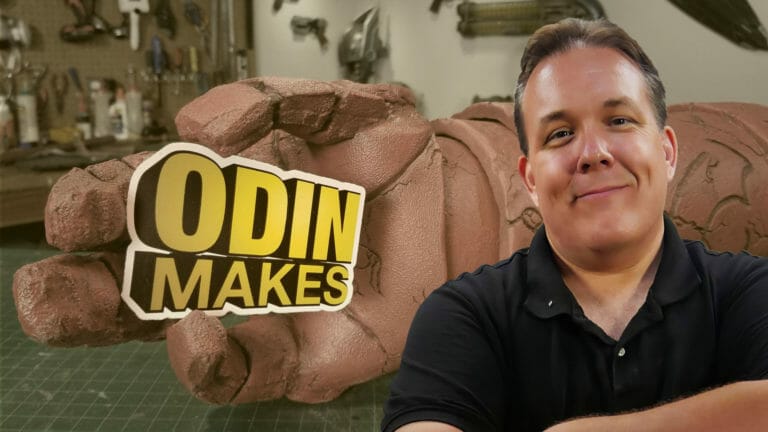
Beyond Geek Spotlight talks to Odin Abbott from Odin Makes about his passion for cosplay, building props, fandom, and more.

Alyssa Gillis interviews content creator, sci-fi fan, self proclaimed nerd, and prop maker extraordinaire Odin Abbott of Odin Makes. Odin not only makes props for his YouTube channel, he also is a works on both sides of the camera for Beyond Geek.
Subscribe to our newsletter for updates, giveaways, and other geek news
*By clicking on the button, you agree with Terms Of Use and Privacy Policy.
Subscribe to our newsletter for updates, giveaways, and other geek news
*By clicking on the button, you agree with Terms Of Use and Privacy Policy.
Subscribe to our newsletter for updates, giveaways, and other geek news
*By clicking on the button, you agree with Terms Of Use and Privacy Policy.